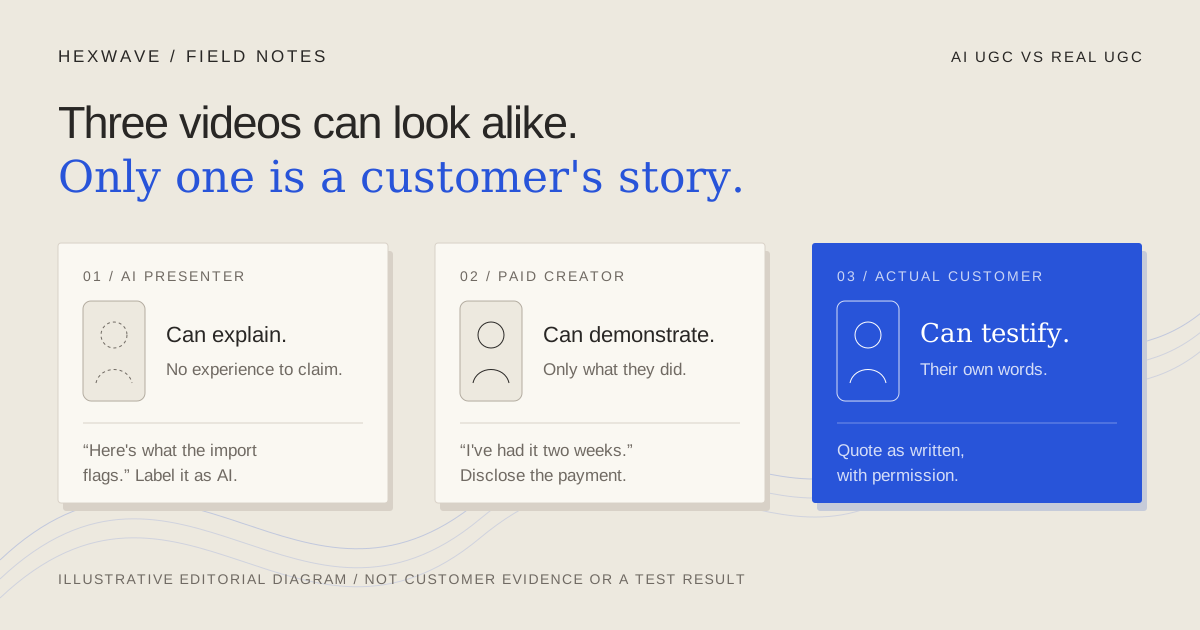
Picture three vertical videos. Each has a person in a kitchen, natural light, a phone held at arm's length and a caption that begins, "Okay, so." One person was generated by an AI tool. One is a creator you paid to film your product last Tuesday. One is a customer who has used it since spring and posted about it without being asked.
A viewer scrolling past can't reliably tell them apart. That is the reason "AI UGC versus real UGC" is the wrong first comparison. The format looks the same on purpose. What differs is whose experience the video is allowed to claim, and that decides almost everything else: what the script may say, what you must disclose, how much you can edit and what the video can prove.
Here is the short answer. An AI presenter can explain and demonstrate what your product does. A paid creator can do that with real hands and real reactions, and can describe their own use if they genuinely used it. Only an actual customer can tell a customer's story. Trouble starts when a video borrows the third kind of authority while being made the first or second way.
This guide is for founders and small teams choosing between these routes for short-form product content. It isn't legal advice. Where the FTC or a platform rule matters, we link the primary text so you or a qualified reviewer can read it.
Three videos that look alike and promise different things
"UGC" originally meant content users made. In marketing it now often means a style: casual, first-person, filmed on a phone. Viraloop's AI UGC guide describes AI UGC as reproducing "the aesthetic of that format" synthetically, which is a fair description. The aesthetic is the shared part. The source of the words isn't.
| Synthetic presenter (AI UGC) | Paid creator demonstration | Actual customer's experience | |
|---|---|---|---|
| Who appears | A generated person or character | A real person you hired or sent product to | A real person who chose and used the product |
| Whose experience can the words carry? | Nobody's. The presenter has none | The creator's own, limited to what they actually did | The customer's own |
| What it can honestly show | What the product does, explained or demonstrated on screen | Handling, setup, first impressions, a real demonstration | Use over time, context, the reason they bought |
| What it can't supply | "I've used this," "it changed my week," any personal result | Long-term results they don't have; your marketing claims as their opinion | A balanced or representative picture, unless you have evidence for that |
| Your control over words | Total | Shared, set by the brief and contract | Little. You can choose whether to use it, not what it says |
The middle row is the one to remember. The other rows follow from it.
The question that sorts them: whose experience is being claimed?
The FTC's Endorsement Guides treat an endorsement as a message consumers are likely to believe reflects the experience of someone other than the advertiser, and the endorser "could be or appear to be an individual". When the FTC revised the Guides in 2023, its announcement said the definition was clarified to include fake reviews and virtual influencers.
Three provisions do most of the practical work for a small brand:
- Endorsements must reflect honest experience, and someone presented as using the product must actually be a bona fide user when they say so.
- People presented as actual consumers should be actual consumers, or the ad should clearly disclose that they aren't. That is 16 CFR 255.2(c), and the Guides' own example involves hired actors in a casual "hidden camera" style ad.
- The FTC's consumer review rule bars creating or spreading testimonials that misrepresent that the reviewer exists, used the product or had the stated experience. The FTC's own announcement names AI-generated fake reviews as an example.
Notice what these rules don't say. They don't ban AI presenters, and they don't make a human creator automatically safe. A paid creator reading "I've used this every day for six months" after two weeks has the same problem as a generated face reading it. The Guides also note that an obviously fictional dramatization isn't an endorsement. The risk lives in the impression a casual first-person video creates, and the UGC style is designed to create exactly the impression that this is a real person's experience.
So the practical test before choosing a route is a script test: underline every sentence that claims personal experience, then ask who actually had it.
Remove the borrowed life from a script
The worked examples below use a fictional product so the choices are visible.
Product (illustrative): a budgeting app for freelancers. Confirmed facts for this exercise: it imports a bank's CSV export, flags transactions without a category and exports a quarterly summary as a PDF. Not established: how much time it saves, any effect on taxes, how customers feel about it. Assets: a demo account with sample data and a screen recording.
Route 1: an AI presenter
First draft: "I was drowning in receipts until I found this. Now my taxes take ten minutes."
Both sentences fail. "I was drowning" and "I found this" describe an experience the presenter can't have had, and "ten minutes" is a result nobody measured. It's an easy failure to write, because the UGC style practically asks for a before-and-after confession.
Revision: "Here's what happens when you import a bank CSV. Anything without a category gets flagged. This export had three." Then cut to the screen recording showing those three rows.
The presenter now works as a guide, not a witness. Everything said can be checked against the screen. The viewer gets an explanation; nobody is invited to believe a stranger's life improved.
The revision also shows where an AI presenter is weakest. It can point at a screen recording well. For a physical product, generated hands may change its shape, controls or packaging between frames, and the frame itself becomes a product claim. Check generated footage against the real item, as the content-review guide explains, or film the product separately and keep the presenter out of the demonstration.
Route 2: a paid creator
Brief as first written: "Say you've used it every month since January and it's the only finance tool you need."
The creator received access twelve days ago. They can't truthfully say the first part, and the second is your opinion placed in their mouth.
Revision: "I've had this for about two weeks. Here's the first import I ran, from my real bank export." The creator shows their own flagged transactions, blurs account details and gives their actual first reaction, including what confused them.
This is the creator's distinct value: a real person doing a real first run, with a reaction you didn't write. Keep the brief to facts they must not get wrong and claims they must not make. Write their opinions for them and you've thrown away the one thing you paid for. Because they're paid, the post also needs a clear material-connection disclosure. Free product counts as well as money.
Route 3: an actual customer
What you have: a customer's reply to an onboarding email: "Found three uncategorized payments I'd completely missed last quarter."
You can't polish this into "Saved me hundreds on my taxes." The customer didn't say it, and you don't know it. You can ask permission to quote the sentence as written, with their name or initials as they prefer, beside a demonstration of the flagging feature.
One more check: if a customer's result concerns a central benefit, the Guides say viewers will likely read it as typical. "Found three payments I'd missed" is a modest, specific statement. A dramatic outcome from one enthusiastic customer would need evidence that it's representative, or a clear statement of what people generally experience.
Choose by the job the video has to do
With the scripts honest, the routes stop competing for the same job. Pick by what the viewer needs to see.
| The video needs to... | Strongest fit | Why | What to watch |
|---|---|---|---|
| Explain a software feature on screen | AI presenter or founder voiceover | The screen recording carries the proof; the presenter only narrates | Label realistic AI; no personal claims |
| Test several openings for the same demo | AI presenter | Lines can be changed without a reshoot, so the demonstration stays constant | Change one thing per variant |
| Show a physical product in real hands | Paid creator or your own hands-only demo | Real handling avoids generated distortions of size, parts or texture | Use the actual product and model |
| Capture an unscripted first reaction | Paid creator | A real first run can't be generated | Disclose the payment or free product |
| Show use over weeks or months | Actual customer | Only someone who lived with the product has this | Permission, representativeness |
| Answer "do people like this?" | Actual customers, plural | Social proof is a claim about real people | Never fill gaps with synthetic reviewers |
| Explain a limitation or objection | Any route, often the founder | Credibility comes from candour, not the face | Keep the honest answer in the cut |
A small brand doesn't have to pick one route forever. One honest pattern is to use synthetic or founder-narrated videos for explanation, a few creators for real-world handling, and real customer words wherever the viewer is asking whether people actually use and like the product.
Edit control is also a liability
AI presenters offer something the other routes can't: change any word, any time, without anyone's schedule. That's useful for testing and for keeping a demo current after a product update.
It also removes the friction that protected you. A creator might refuse to say something untrue. A customer's words are fixed. An AI presenter will say whatever the script says, so your review has to supply the judgment. Treat each regenerated version as a new post for review, not a minor edit of an approved one.
With a creator, control is whatever the contract says: how many revisions, whether you can recut the footage, whether you can remove their face or replace the voiceover. With a customer, editing is limited to trimming and choosing. Cutting a sentence so it reverses its meaning ("It's great, once you get past the setup" becoming "It's great") is putting words in their mouth.
Rights: who has to say yes
Each route has a different permission question, and none is answered by having the file on your laptop.
- AI presenter. Read the tool's current terms for commercial use, paid ads and the presenter's likeness. If a stock presenter is modelled on a real person, ask what that licence permits. Never generate a real person's face or voice without their consent; TikTok's AI content page says it doesn't allow an adult private figure's likeness without permission, or AI depictions of public figures endorsing products.
- Paid creator. Agree in writing where the video may run (their account, yours, paid ads), for how long, and whether you can edit it. Organic posting on their account and running the same video as an ad are different permissions, so name each use, and what you're paying for it, in the agreement.
- Actual customer. Their post belongs to them. Ask before reposting, quoting in an ad or putting their face in your video. Ask for the specific use, not "can we use this sometime," and keep the reply with the asset.
Disclosure answers three separate questions
Teams often treat "add the AI label" as the whole disclosure job. It's one of three questions, and each has a different answer.
Is the realistic content AI-made? That's a platform label. TikTok requires labeling AI-generated or significantly edited content showing realistic people or scenes. Meta requires its AI-disclosure tool for organic photorealistic video or realistic-sounding audio that was digitally created or altered. YouTube requires disclosure for meaningfully altered or generated photorealistic content, and says AI help with scripts or ideas doesn't need it. A realistic synthetic presenter belongs in the "label it" column on all three.
Is the speaker paid or connected to you? That's a material-connection disclosure, required for paid creators and gifted product under the Endorsement Guides. The FTC has said a platform's built-in disclosure tool might not be adequate on its own, so make it clear in the video or caption as well.
Is the person presented as a real customer? If they aren't one, they shouldn't be presented as one, or the ad should clearly say they're not actual customers.
The third question is the reason a label can't rescue a bad script. An "AI-generated" tag tells viewers how the video was made. It doesn't turn a synthetic person saying "this saved my business" into a real customer's experience. Fix the words first, then label the production method.
Platform rules change. These were checked on 14 October 2026; reread the linked pages before a campaign, and ask a qualified reviewer about anything they don't plainly cover.
Compare cost per approved video, not cost per render
Price comparisons between these routes usually compare a generation fee with a creator fee. That leaves out most of the cost. We haven't priced specific vendors or creators for this guide, so the table lists what to count rather than what it will cost you.
| Cost component | AI presenter | Paid creator | Actual customer |
|---|---|---|---|
| Direct spend | Subscription or credits, including regenerations | Fee, product, shipping; usage rights and ad rights often extra | Usually none; any incentive is a connection to disclose |
| Your time | Script writing, reviewing each version, fixing product depiction | Briefing, contracting, reviewing drafts | Finding usable material, asking permission |
| Waiting time | Low | Depends on the creator's schedule and revisions | Unpredictable; you can't commission it |
| Hidden cost | Versions rejected in review | A video you can't use because rights or claims were wrong | Not being able to make it on demand |
To compare your own options, add up the spend and hours for one batch, then divide by the number of videos that passed review and that you're allowed to use where you intend to post them. A cheap route with a high rejection rate can cost more per usable video than it first appears. A creator video with organic-only rights may be inexpensive until you want to run it as an ad.
A mix that keeps each route honest
For a small team, a workable starting point looks like this:
- List the questions your viewers ask: what it does, how it feels in the hand, whether real people use it.
- Match each question to the route that can answer it truthfully, using the job table above.
- Write scripts, then underline every first-person experience claim and check who actually had it.
- Decide disclosures per post: AI label, material connection, and whether anyone is presented as a customer.
- Keep the permission or licence beside each asset before scheduling.
Hexwave is in early access. The talking-presenter format we're planning uses ready-made AI characters, never a real person's face or voice, with AI content labelled. When it ships, it will sit in the first column of the job table: explaining and demonstrating, not testifying. The format library shows the other formats we're building around, and our tool comparison covers products you can use today.
Before you approve the next casual first-person video, whichever way it was made, read every "I" in the script aloud and name the person who lived it. If you can't, rewrite the line as an explanation or a demonstration. The video gets more honest and, often, more useful, because the viewer learns what the product does instead of being asked to trust someone they've never met.
Sources & reference material
- AI UGC Explained: Generate User-Style Video Without Creators — Viraloop, checked October 14, 2026. Vendor article, cited only for its definition of AI UGC as a synthetic reproduction of the UGC aesthetic. Its cost and performance figures are not used or verified here.
- 16 CFR 255.2: Consumer endorsements — Legal Information Institute (text of the FTC Endorsement Guides), checked October 14, 2026. Paragraph (c): ads presenting people as actual consumers should use actual consumers or clearly disclose that they are not. Paragraph (b): a consumer result on a key attribute implies it is representative. Guidance text, not legal advice for a specific campaign.
- 16 CFR 255.1: General considerations — Legal Information Institute (text of the FTC Endorsement Guides), checked October 14, 2026. Endorsements must reflect the endorser's honest experience; an endorser represented as a user must be a bona fide user at the time. Does not address AI presenters by name.
- 16 CFR 255.0: Purpose and definitions — Legal Information Institute (text of the FTC Endorsement Guides), checked October 14, 2026. Endorser 'could be or appear to be an individual'. Guides are administrative interpretations, not a rule; an obviously fictional dramatization is not an endorsement (Example 2).
- 16 CFR 255.5: Disclosure of material connections — Legal Information Institute (text of the FTC Endorsement Guides), checked October 14, 2026. Payment and free or discounted products are material connections that must be disclosed clearly and conspicuously.
- FTC announces updated advertising guides to combat deceptive reviews and endorsements — Federal Trade Commission, checked October 14, 2026. June 2023 revision clarifies that endorsements can include fake reviews and virtual influencers, and that a platform's built-in disclosure tool might not be adequate.
- 16 CFR 465.2: Fake or false consumer reviews, consumer testimonials or celebrity testimonials — Legal Information Institute (text of the FTC Consumer Reviews and Testimonials Rule), checked October 14, 2026. Bars creating or disseminating testimonials that misrepresent that the reviewer exists, used the product, or had the stated experience. Rule text; does not mention AI by name.
- FTC announces final rule banning fake reviews and testimonials — Federal Trade Commission, checked October 14, 2026. FTC's own summary names AI-generated fake reviews and reviewers without actual experience; civil penalties for knowing violations. Does not quantify penalties.
- Disclosing use of altered or synthetic content — YouTube Help, checked October 14, 2026. Disclosure required for meaningfully altered or generated photorealistic content, including realistic scenes that didn't occur; not for scripts, ideas or clearly unrealistic content. The page does not separately name a fully synthetic person.
- Misinformation (Community Standards) — Meta Transparency Center, checked October 14, 2026. Requires use of Meta's AI-disclosure tool for organic photorealistic video or realistic-sounding audio that was digitally created or altered; penalties possible. Covers Instagram; ad rules are separate.
- Integrity and Authenticity (Community Guidelines) — TikTok, checked October 14, 2026. Read through TikTok-hosted search excerpts; the page did not load directly from our network on the check date. Requires labeling AI-generated or significantly edited content showing realistic people or scenes. Recheck the live page before publication.
- Supporting responsible, transparent AI-generated content — TikTok, checked October 14, 2026. Read through TikTok-hosted search excerpts only. States that adult private figures' likeness may not be used without permission and that AI depictions of public figures endorsing products are not allowed. Recheck before publication.