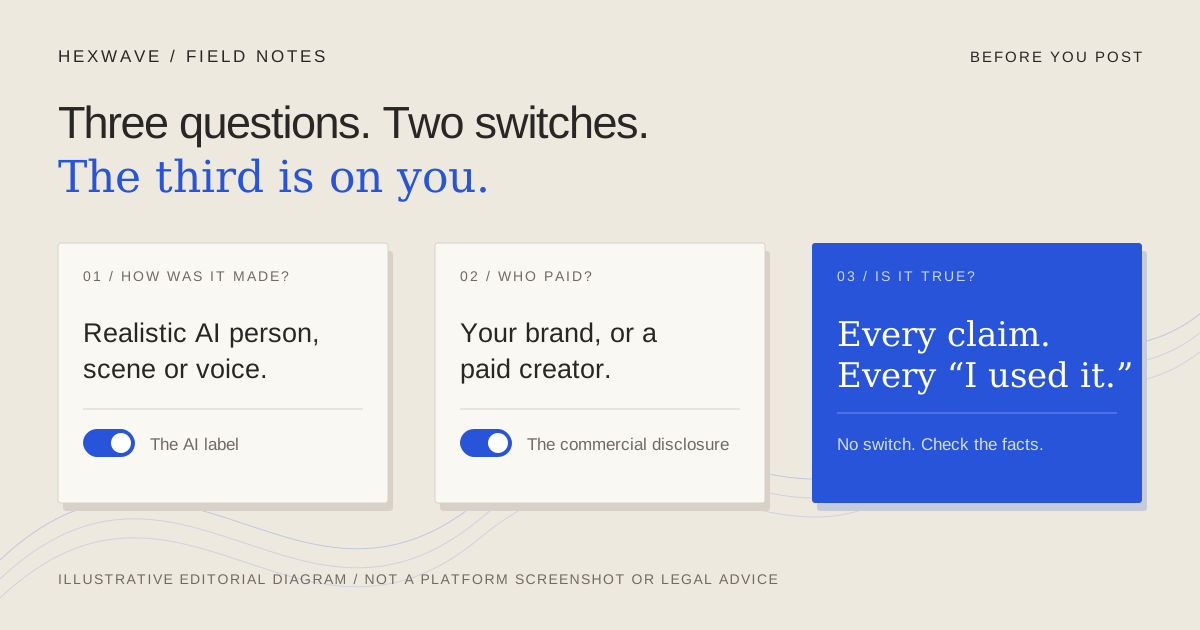
Before a product video goes out, it has to answer three questions, and each one has a different owner.
- How was it made? If a realistic person, scene or voice was generated or altered with AI, TikTok, Instagram and YouTube each want you to say so. That's the platform AI label.
- Who paid? If the post promotes a business, or a creator was paid or sent free product, there's a commercial disclosure. That's a separate switch on each platform, and sometimes words in the video as well.
- Is it true? Every claim about the product needs a basis, and nobody may be presented as a customer with an experience they didn't have. No platform has a switch for this one.
The first two are settings you turn on. The third is work you do on the script and the edit. Teams tend to confuse them because they arrive at the same moment, on the same posting screen, and because ticking "AI-generated" feels like honesty. It is honesty about the production method. It says nothing about whether the person on screen ever used the product.
This guide works through all three for TikTok, Instagram Reels and YouTube Shorts, then applies them to three posts: a synthetic presenter, an altered product scene and an ordinary edit. The platform rules below were checked on 14 October 2026 and change often, so open the linked pages before you rely on a detail. This is operational guidance for a US team, not legal advice; for a specific campaign, especially health, financial or comparative claims, ask a qualified lawyer.
For the general review pass on a draft (facts, visuals, voice and permissions), start with how to review AI-generated social content. This article picks up where that review reaches the posting screen.
The three disclosures at a glance
| Question | What triggers it | TikTok | Instagram (Meta) | YouTube Shorts |
|---|---|---|---|---|
| How was it made? | Realistic content generated or meaningfully altered with AI | Label realistic AI-generated or significantly edited content with the AI-generated content setting | Use the AI-disclosure tool for photorealistic video or realistic-sounding audio that was digitally created or altered; shown as "AI info" | Disclose realistic altered or synthetic content in YouTube Studio when uploading |
| Who paid? | Promoting a business, or a creator receiving money or product | Content disclosure setting: "Your brand" shows "Promotional content"; "Branded content" shows "Paid partnership" | Paid partnership label for content influenced by a business partner for value | Paid promotion setting for content influenced by a brand partner for value; covers Shorts |
| Is it true? | Any objective claim, endorsement or testimonial | No setting. FTC advertising law applies to the claim itself | No setting | No setting |
The rows are independent. One post can need all three, and a post with no AI in it at all can still fail the third row.
AI labels: what each platform asks for
The three platforms agree on the core idea, realistic synthetic content gets labelled, and differ on the edges. Those edges are where ordinary edits get confused with synthetic ones.
TikTok requires creators to label AI-generated or significantly edited content that shows realistic-looking scenes or people, according to its Integrity and Authenticity guidelines. You turn on the AI-generated content setting in the post's options before publishing. TikTok also applies labels itself, including when an upload carries C2PA Content Credentials from the tool that made it. Separately, the same guidelines don't allow AI-generated content that shows a public figure endorsing a product. That's a content rule, not a labelling one.
Instagram follows Meta's rule. Meta's Community Standards require people to use its AI-disclosure tool whenever they post organic content with "photorealistic video or realistic-sounding audio that was digitally created or altered," and say Meta may apply penalties if they don't. The label viewers see is "AI info," and Meta also adds it on its own when it detects industry-standard AI indicators in a file. Note the word "audio": a generated voiceover over real footage is inside Meta's wording.
YouTube has the most detailed list. Its disclosure page asks creators to disclose content that makes a real person appear to say or do something they didn't, alters footage of a real event or place, generates a realistic scene that didn't occur, or creates music that is the main focus of the video. It then lists what doesn't need disclosure: colour and lighting adjustments, beauty filters, background blur, captions, using AI to write a script, title or thumbnail, upscaling, and cloning your own voice for a voiceover. The setting sits in YouTube Studio's upload details. As with the others, files carrying C2PA metadata can be labelled automatically.
Two practical consequences follow. First, YouTube's exemption list is a useful calibration even for the other platforms: tidying real footage is not the same act as fabricating a scene. Second, the platforms don't line up perfectly. A cloned founder voice is listed as exempt on YouTube, but realistic-sounding audio that was digitally created falls within Meta's wording. When the rules split, label for the stricter one on that platform rather than assuming one decision covers all three.
Commercial disclosures are about money, not software
A commercial disclosure answers a different question: is this post selling something, and is someone being paid to say it? It applies to a filmed demo with no AI in it exactly as it applies to a generated one.
On TikTok, the content disclosure setting has two options. "Your brand" is for promoting your own business and shows a "Promotional content" label. "Branded content" is for posting on behalf of another business and shows "Paid partnership." Once the post is live, the label can't be switched; fixing a wrong choice means removing the post and publishing again. A brand account posting its own product is the "Your brand" case.
On Instagram, the paid partnership label belongs to branded content: a creator's or publisher's post influenced by a business partner in exchange for something of value, including free product. Your brand's own Reel about your own product isn't branded content under that definition. A creator you sent product to is.
On YouTube, the paid promotion setting in Studio adds a disclosure label at the start of the video, and the branded content policy says it covers Shorts. Its definition centres on a brand partner, so it's the creator's switch when you sponsor them, not obviously yours on your own channel.
The platform tool may not be the whole job. The FTC's guide for influencers says to put the disclosure in the video itself for video content and not to assume a platform's tool is good enough. If you're paying a creator, write "ad" or "paid partnership with [brand]" into the brief as a spoken or on-screen line, as well as asking them to turn the setting on.
Claims: the part no label covers
US advertising law cares about what a post says and shows, whoever or whatever says it. Four FTC sources do most of the work for a small product team.
- Substantiation. Advertisers need a reasonable basis for objective claims before the ad runs. If the claim names a level of proof, such as "tests show" or "doctors recommend," you need at least that level (FTC policy statement, 1984). "Doesn't leak" is an objective claim. So is a scene that implies it.
- Endorsements. An endorsement must reflect the honest opinion or experience of the endorser, and someone presented as a user must actually have been one (16 CFR 255.1). In the FTC's words, an endorsement "can't be used to make a claim the marketer of the product couldn't legally make" (Endorsement Guides FAQ). Putting a sentence in a presenter's mouth doesn't lower the evidence it needs.
- Fake testimonials. Since 21 October 2024, an FTC rule has barred businesses from writing or creating a testimonial that misrepresents that the person exists, used the product, or had the stated experience (16 CFR 465.2). The FTC's announcement names AI-generated fake reviews as an example, and the rule allows civil penalties against knowing violators.
- AI avatars specifically. The FTC's Q&A on that rule says there's no blanket ban on AI-generated avatars in marketing. What makes an avatar's statement a problem is the same thing that makes a human's statement a problem: a fake or false testimonial underneath it.
Here is why a label can't rescue an invented testimonial. The AI label tells a viewer that the person on screen was generated. It doesn't tell them that the six months of daily use the person describes never happened, and it does nothing about the leak claim inside that sentence. The Endorsement Guides do let advertisers present people who aren't real customers if they clearly disclose it (16 CFR 255.2(c)), but the same section treats a consumer-style endorsement about performance as a claim that the product works for the purpose shown. A disclosure changes who the viewer thinks is speaking. The claim still needs its evidence.
So fix the words first. Then label how the video was made.
Three posts, worked through
The product below is fictional, and so are the posts. They're constructed to show decisions, not taken from a real campaign or test.
Confirmed facts (illustrative): a collapsible silicone lunch box folds to about two inches tall, has a steam vent in the lid and a dishwasher-safe lid. Nothing has been established about leak resistance, heat retention or microwave times. The brand posts from its own accounts and pays no creators.
1. A synthetic presenter
The draft: a realistic AI-generated woman sits at a kitchen counter, holds up the box and says, "I've taken this to work every day for six months and it's never leaked in my bag."
Claims. "Every day for six months" is an experience nobody had. That's the testimonial problem, and the AI label doesn't touch it. "Never leaked" is an objective claim the facts don't support, whoever says it.
Rewrite. The presenter explains rather than testifies: "This lid has a steam vent. Watch it fold down to about two inches." Cut to real footage of the actual box folding. The presenter narrates the product; the footage carries the proof.
AI label. Yes on all three platforms. A photorealistic generated person with a generated voice is squarely inside TikTok's and Meta's wording. YouTube's list doesn't name a wholly synthetic presenter, but a realistic scene that didn't occur is on it, and that's our reading of a generated person talking at a counter.
Commercial disclosure. "Your brand" on TikTok. No paid partnership on Instagram or paid promotion on YouTube, because no partner is involved.
If the script needs a customer's experience, it needs a customer. That's a different production, with its own permission and disclosure questions, covered in AI UGC versus real customer content.
2. An altered product scene
The draft: real footage of the box being opened, with the plain kitchen background replaced by a generated mountain picnic and a wisp of steam added rising from the food.
Claims. The steam is the problem. Rising steam after a hike implies the box keeps food hot, and heat retention isn't in the facts. A scene can make a claim without a word of copy. Remove the steam, or establish the claim before keeping it.
AI label. Yes. A realistic scene that didn't occur is on YouTube's list, the edit is a significant realistic alteration for TikTok, and it's photorealistic video digitally altered for Meta. Real product footage underneath doesn't change that; the setting you're showing never existed.
A simpler option. Film the box on an actual picnic table. You lose the mountain and gain a scene you don't need to explain.
Commercial disclosure. Same as above: "Your brand" on TikTok.
3. An ordinary edit
The draft: the founder films the box folding on a desk, trims the clip, corrects the colour and adds auto-generated captions. An AI tool helped write the script. The founder records the voiceover in their own voice. The caption reads: "The only lunch box that fits in a jacket pocket."
AI label. On YouTube's list, every step here is exempt: colour correction, captions and AI help with the script. Nothing realistic was generated or altered, so TikTok's and Meta's requirements aren't triggered either. Check whether your editing app writes Content Credentials into the export; if it does, a platform may add a label automatically, and that isn't a reason to strip the metadata.
Claims. The caption is where this post fails. "The only lunch box that fits in a jacket pocket" is a superlative about every competing product. Without evidence for it, write what the footage shows: "Folds to about two inches. Here it is going into a jacket pocket."
Commercial disclosure. "Your brand" on TikTok, as before.
One change would move this post into a different row. If the founder's voice were cloned instead of recorded, YouTube would still list it as exempt, but realistic-sounding audio that was digitally created falls within Meta's rule. The same file would then need the AI-disclosure tool on Instagram and not on YouTube.
The pattern across the three: the post with the most AI had a testimonial problem, the altered scene had an implied claim, and the post with almost no AI had a superlative. Labels sorted the first two questions every time. The third needed someone with the product facts open.
The pre-publish checklist
Do these in order. Fixing a claim can change the edit, and a changed edit can change the label.
Claims and people
- List every objective claim in the script, captions, on-screen text and voiceover: sizes, materials, results, comparisons, "only," "best," "never."
- Match each one to a current source your team owns. Remove or rewrite any you can't match.
- Look at what each scene implies: steam, a full bag, a smiling "after" shot, a crowd. Treat an implied claim like a written one.
- Find every first-person statement. If the speaker is generated, an actor or a paid creator, remove experiences they didn't have.
- Confirm that no real person's face, voice or name appears without permission, and that no public figure appears to endorse the product.
How it was made
- Note which elements were generated or altered: people, voices, backgrounds, product shots, music.
- If any is realistic, turn on the AI label on each platform: TikTok's AI-generated content setting, Meta's AI-disclosure tool, YouTube Studio's disclosure.
- Where the platforms split (a cloned voice, a generated backdrop), decide per platform and record why.
Who paid
- Brand's own post: choose "Your brand" in TikTok's content disclosure setting.
- Paid or gifted creator: they use "Branded content" on TikTok, the paid partnership label on Instagram and paid promotion on YouTube, plus a spoken or on-screen disclosure in the video.
Record
- Save the approved file, caption, the label choices per platform and the source for each claim. If anyone edits the post afterwards, run the list again on the new version.
Before scheduling, the format checks for each destination are in posting one video to TikTok, Reels and Shorts.
Hexwave is in early access. The talking-head format we're building uses ready-made AI characters, never a real person's face or voice, and AI content will be labelled. A label from any tool, ours included, only answers the first question. The claim check stays with someone who knows the product, which is why the workflow we're building puts review before anything is scheduled.
When the checklist isn't enough
The list above handles the everyday cases. Bring in a qualified reviewer when a post makes health, safety, financial or environmental claims, compares you with a named competitor, uses a real person's likeness or voice, runs as a paid ad rather than an organic post, or targets an audience outside the US. Platform ad policies and other countries' rules differ from everything above.
For the rest, the habit is short. Open the product facts beside the draft. Fix what it says, then label how it was made, then mark who paid. If the order ever feels backwards, picture the lunch box presenter with a perfect AI label and a six-month story that never happened. The label was correct. The post still wasn't.
Sources & reference material
- Disclosing use of GenAI content — YouTube Help, checked October 14, 2026. Lists the four cases that need disclosure (real person shown saying or doing something they didn't, altered footage of a real event or place, realistic scene that didn't occur, AI music as the main focus) and the minor edits that don't (colour and lighting, beauty filters, captions, AI help with scripts or titles, cloning one's own voice). C2PA metadata can trigger an automatic label. The page doesn't mention Shorts by name or name a wholly synthetic presenter.
- Add branded content restrictions & disclosure labels — YouTube Help, checked October 14, 2026. The paid promotion setting in YouTube Studio adds a disclosure label at the start of the video; creators and partners remain responsible for legal requirements. Does not address a brand promoting its own product.
- YouTube Branded Content Policies — YouTube Help, checked October 14, 2026. Defines branded content as content influenced by a brand partner in exchange for value; applies to Shorts. Silent on self-promotion of one's own business.
- Misinformation (Community Standards) — Meta Transparency Center, checked October 14, 2026. Requires the AI-disclosure tool for organic photorealistic video or realistic-sounding audio that was digitally created or altered; penalties possible. Meta may add its own label for high-risk content on public-interest matters. Ads are governed separately.
- Labeling AI Content — Meta Transparency Center, checked October 14, 2026. Page updated 19 February 2025. The label is shown as AI info and is added from industry-standard AI indicators or from the poster's disclosure. Notes that some AI-edited content may not be captured. No menu path for posting.
- Our approach to labeling AI-generated content and manipulated media — Meta, checked October 14, 2026. Originally 5 April 2024; records the July 2024 rename of the Made with AI label to AI info. Company announcement, not a policy text.
- Branded content policies — Meta Business Help Center, checked October 14, 2026. Page body did not render for our fetch; the definition used (creator or publisher content influenced by a business partner for value, tagged with the paid partnership label) comes from Meta's search-indexed text. Recheck the live page before publication.
- Integrity and Authenticity (Community Guidelines) — TikTok, checked October 14, 2026. Could not be loaded directly from our network on the check date; read through TikTok-hosted search excerpts. Requires labeling AI-generated or significantly edited content showing realistic scenes or people; does not allow AI content showing public figures endorsing products. Recheck the live page before publication.
- AI-generated content — TikTok Support, checked October 14, 2026. Could not be loaded directly from our network on the check date; read through search excerpts. Describes the creator AI-generated content setting and automatic labels, including from C2PA Content Credentials. Exact menu wording not confirmed; recheck in the app.
- About the Commercial Content Disclosure setting for creators — TikTok Ads Help Center, checked October 14, 2026. Read through TikTok-hosted search excerpts only. Your brand produces a Promotional content label; Branded content produces Paid partnership; the label can't be changed after publishing. Recheck before publication.
- FTC Policy Statement Regarding Advertising Substantiation — Federal Trade Commission, checked October 14, 2026. Dated 23 November 1984. Advertisers need a reasonable basis for objective claims before they run; claims like tests prove require at least the stated level of support. Not specific to AI or social video.
- FTC's Endorsement Guides: What People Are Asking — Federal Trade Commission, checked October 14, 2026. Business guidance. An endorsement can't be used to make a claim the marketer couldn't legally make; the company is responsible for what others say on its behalf. Not a rule and not campaign-specific advice.
- 16 CFR 255.1: General considerations — Legal Information Institute (text of the FTC Endorsement Guides), checked October 14, 2026. Endorsements must reflect the endorser's honest opinions, findings, beliefs or experience; an endorser presented as a user must be a bona fide user. Doesn't name AI presenters.
- 16 CFR 255.2: Consumer endorsements — Legal Information Institute (text of the FTC Endorsement Guides), checked October 14, 2026. (a) A consumer endorsement about performance represents the product is effective for the depicted purpose. (c) People presented as actual consumers should be actual consumers or be clearly disclosed as not. A disclosure of that kind does not substantiate the performance claim.
- 16 CFR 465.2: Fake or false consumer reviews, consumer testimonials or celebrity testimonials — Legal Information Institute (text of the FTC rule), checked October 14, 2026. Bars a business from writing, creating or selling a testimonial that misrepresents that the testimonialist exists, used the product or had the stated experience. Rule text does not mention AI by name.
- Federal Trade Commission announces final rule banning fake reviews and testimonials — Federal Trade Commission, checked October 14, 2026. 14 August 2024 announcement; names reviews by someone who does not exist, such as AI-generated fake reviews, and allows civil penalties against knowing violators.
- The Consumer Reviews and Testimonials Rule: Questions and Answers — Federal Trade Commission, checked October 14, 2026. November 2024. Rule effective 21 October 2024. No blanket ban on AI avatars; an avatar's statement can be a prohibited testimonial if the underlying testimonial is fake or false. A business shouldn't supply testimonial text without a reasonable basis that it is truthful.
- Disclosures 101 for Social Media Influencers — Federal Trade Commission, checked October 14, 2026. November 2019. For video, put the disclosure in the video, not only the description; don't assume a platform's disclosure tool is good enough. Written for endorsers, not for a brand's own posts.