The quickest way to copy a trend takes the wrong part of it. You keep the creator's lines, re-perform their delivery, lift their sound and add a logo at the end. Then you drop the one part that was free to take: the structure that made the video work.
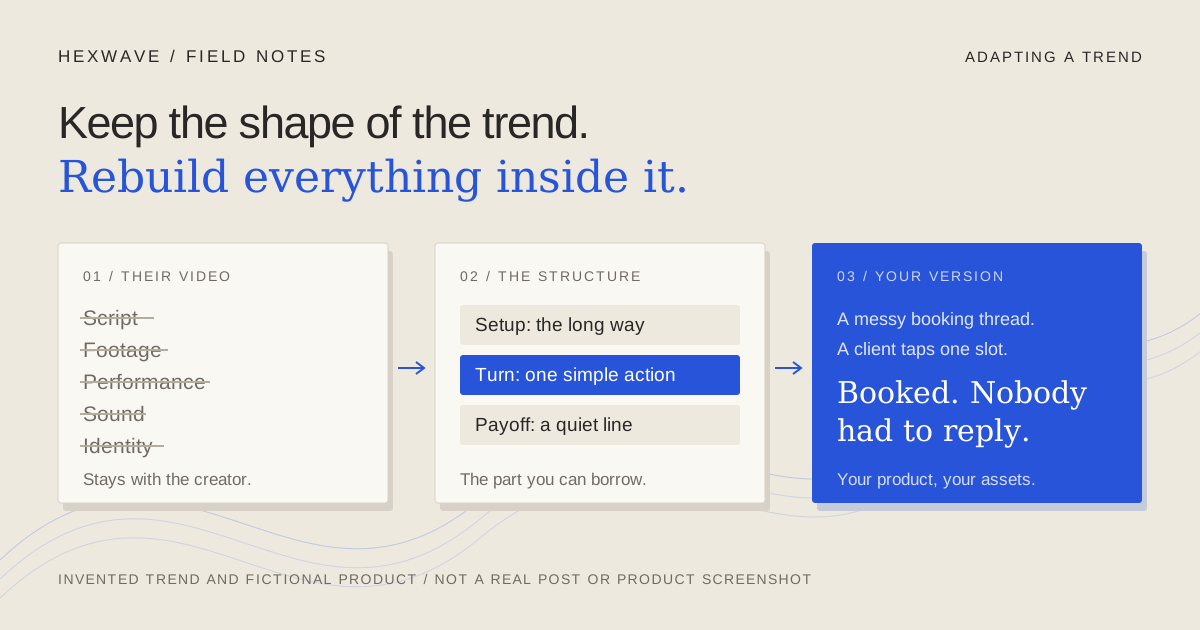
You can use TikTok trends for business without copying the creator by treating a trend as two separate things. One is the shape: the order of beats, where the turn lands and what the viewer expects to happen next. The other is the creator's expression: their script, footage, performance, sound and identity. Keep the shape. Rebuild everything inside it from your product and your own assets. If the trend only works with the parts you can't take, skip it.
This guide works through that with an invented trend and a fictional product. Neither describes a real post or customer. It doesn't cover how to find trends. It starts after you've found one: deciding what you're allowed to borrow and what your product can actually fill in.
A trend is a shape with someone else's work inside it
US copyright law draws a version of this line itself. Under 17 U.S.C. § 102(b), copyright protection doesn't extend to an idea, procedure, system or concept, however it's expressed. TikTok's intellectual property policy puts it in platform terms: copyright covers the original expression of an idea, not the underlying idea or facts. Content that infringes can be removed, and repeat infringers can lose their accounts.
That gives you a working sorting rule:
| Part of the trend video | Example | Yours to use? |
|---|---|---|
| Beat structure | A setup, a hard cut, a quiet payoff | Yes. This is the format. |
| Viewer expectation | "Something's about to be undercut" | Yes, as long as your version delivers on it |
| Timing pattern | A fast setup, then a long pause | Yes |
| Script and on-screen wording | The creator's lines, captions or catchphrase | No. Write your own. |
| Footage | Their video, or a screen recording of it | No, without permission |
| Performance | Their specific delivery, gestures or bit | Common movements, yes. Not a copy that reads as them. |
| Identity | Their face, voice, name, handle or look | No. That includes AI imitations and look-alikes. |
| Sound | The audio the trend is set to | Only through a route that permits your use (see below) |
A quick practical test helps: could a viewer mistake your post for the original creator's, or think that creator made or endorsed it? If they could, you're too close. That second question matters more than it might seem. The FTC's Endorsement Guides define an endorsement to include depictions of a person's name, likeness or other identifying personal characteristics. A sound-alike voice or a look-alike performer can therefore suggest a real person's approval of your product, even if no one ever says so.
Choose a trend your product can actually fill
Many trends won't suit your product, and that's fine. Before you write anything, check four things.
The turn needs a slot your product can fill truthfully. Most trend structures have a turn: the cut, the reveal or the reversal. Ask what your product would be at that moment. If the answer needs a claim you can't show, such as "fixes everything" or "saves you hours", the trend is asking for evidence you don't have.
You need to be able to make it with assets you control. A trend built on a dramatic location, a group of performers or a specific song may be out of reach. A trend built on a screen, a desk and on-screen text probably isn't.
Your buyers have to be the people watching it. A format popular with teenagers making jokes about school doesn't automatically reach the operations manager who buys your software. You can still borrow the structure, but say why you expect your audience to recognise it.
Check what the joke is aimed at. Some trends start with a real person's embarrassing moment, a tragedy or a group being mocked. A product doesn't belong there, however neat the structure is.
Extract the structure without the creator's nouns
Here's the invented trend for this exercise. A creator shows a ridiculous multi-step routine for a simple task, filmed in quick cuts and captioned like a serious tutorial. Then there's a hard cut to someone doing the same thing in one move. The video ends on a few seconds of silence with a short caption.
Now describe it without using any of its nouns: no kitchen, no coffee, no creator, none of their wording. Write what each beat does:
- Setup. A recognisable, overcomplicated way of doing something, shown fast and played completely straight.
- Turn. A hard cut to the same result reached in one simple action.
- Payoff. A held beat with one line that names the difference. The viewer gets the joke a moment before the text confirms it.
That beat sheet is the part you can take. If your notes still contain the creator's lines, objects or catchphrase, you haven't extracted the structure yet. You've only summarised their video.
The neutral version also makes the fit test sharper. This structure only works if your product genuinely replaces a complicated routine with a simple action that can be filmed. Plenty of products don't. If yours doesn't, this trend isn't for you.
Write a fresh scenario around a confirmed fact
Fictional product facts for this exercise: a booking page for one-person studios. Clients choose an open slot from a shared link. The booked slot then disappears for everyone else, and the client gets a confirmation email automatically. Nothing has been established about time saved, fewer no-shows or revenue.
Now fill each beat from those facts and from the owner's real workaround, not from the original video:
| Beat | A copy (don't make this) | An adaptation |
|---|---|---|
| Setup | The creator's routine and captions, re-performed with the product placed in shot | The owner's actual booking routine: a message thread offering times, a client asking about a different day, a paper diary with a crossed-out slot. All on a test phone with fictional contacts. |
| Turn | The creator's cut, with a logo added | A client opens the booking link and taps an open slot |
| Payoff | The trend's caption and sound | The slot greys out on the owner's calendar while the confirmation email arrives. Caption: "Booked. Nobody had to reply." |
The structure is the same in both columns: a straight-faced complicated setup, a hard cut, a quiet payoff. Everything the viewer actually sees and reads in the adaptation comes from the product and the owner's situation.
Look at the payoff caption, too. "Nobody had to reply" is supported, because the confirmation is automatic and the shot shows it. "Never lose a booking again" would be a promise the footage can't back up. The trend gives you a payoff slot, but your product facts decide what goes in it. For more on keeping the opening line and the proof together, see the guide to TikTok hooks for product videos.
One more test before you film: would this post make sense to someone who has never seen the trend? In this case it would. A person who has never seen the original still watches a messy booking process turn into a single tap. That matters, because trends fade. A post that only works as a reference starts to lose its meaning on the day the trend does. A post that still works on its own can stay useful after the trend has gone.
Source every asset yourself
Once the scenario is written, list what each shot needs and where it will come from.
Pictures. Use your own screen recordings and product footage, with fake data on test accounts. Use people only if they've agreed to appear; that includes staff. Licensed stock and generated images are fine where their terms allow your use. Don't download the creator's video, screen-record it or trace their framing shot by shot. If you're demonstrating software, the short-form product demo guide covers capturing a task cleanly.
People and voices. Don't recreate the creator, whether with a look-alike, a voice clone, a face swap or an AI character styled to resemble them. That goes for any recognisable person. As mentioned above, a likeness can suggest an endorsement nobody gave.
Sound. This is where a business has fewer options than a person posting for fun. TikTok's Commercial Music Library page says its songs are pre-cleared for commercial use. It also says songs in the General Music Library are not pre-cleared for commercial content and "are not available for use by any brand or business." So the track a trend is famous for may not be available to you at all. The usual alternatives are original voiceover, a Commercial Music Library track, or music you've licensed separately on terms that cover your use. The page doesn't say a cleared track can follow your export to Instagram or YouTube, so check each destination separately. The guide to posting one video to TikTok, Reels and Shorts covers that.
Labels. If your post promotes your product, TikTok's help center says to turn on the commercial content disclosure setting, which offers a "Your brand" option alongside "Branded content". Posts without the right disclosure may be removed or restricted. If a creator is paid to make the trend post for you, TikTok's branded content policy applies as well. If any shot is AI-generated or significantly edited and shows realistic-looking scenes or people, TikTok's community guidelines require you to label it. We haven't checked the current in-app steps for these settings; confirm them on the upload screen.
When to skip the trend
Trend content creates its own time pressure, which makes it easy to post something you'd reject on a calmer day. Skip the trend if any of these is true:
- The payoff depends on something you can't use. If the joke only works with the original sound, the creator's face or their exact line, there's nothing left to adapt.
- The turn needs an unsupported claim. If the only product moment that fits is one you can't show on screen, writing a more confident caption won't fix it.
- Your version only makes sense as a reference. If it fails the "never seen the trend" test and you're already late, it's likely to land after the moment has passed.
- The source is at someone's expense. If the trend began with a real person's mistake or distress, or punches at a group, leave it.
- You'd have to fake the setup. If your customers don't really have the complicated routine, you'd be inventing a problem to make the joke land. That's an invented testimonial in a different form.
Skipping a trend loses you very little. The structure is still useful. Save the neutral beat sheet, and you may find a product fact that fits it next month, when nobody is rushing you.
A trend-fit worksheet
Use this before you film. If any row fails, fix it or let the trend go. The answers in the right-hand column are for the fictional booking page.
| Question | It passes if | Illustrative answer |
|---|---|---|
| What does each beat do, described without the creator's nouns? | Your beat sheet would make sense to someone who's never seen the original | Straight-faced complicated setup → hard cut → quiet payoff |
| Which confirmed product fact fills the turn? | You can show it on screen, unedited | A client books from a link; the slot disappears |
| Which claim goes in the payoff? | The footage proves it | "Nobody had to reply" (confirmation is automatic) |
| Where does every shot come from? | You own it, have licensed it or have consent | A test phone, fictional contacts, the owner's own calendar |
| What's the sound? | Original, from the Commercial Music Library, or licensed for each destination | Original voiceover, no music bed |
| Could anyone mistake it for the creator's post or think they endorsed it? | No | No: the script, footage and people are all different |
| Which labels apply? | Commercial disclosure on; AI label if any realistic shot is generated | "Your brand" disclosure; no generated shots |
| Does it work without the trend? | Yes, or you can post it while the trend is still current | Yes |
Before publishing, review the finished export, not just the brief. A replaced shot or a last-minute caption can undo the checks above. The guide to reviewing AI-generated social content has a review routine that also works for posts made by hand.
Where this fits in Hexwave
Separating a reference video's structure from its expression, then rebuilding it around confirmed product facts, is part of the workflow we're building into Hexwave. The intent is to keep a reference's format and pacing while the words, pictures and claims come from your product. It's planned and not available yet. Hexwave is in early access, so for now the worksheet above is the working version. The format library shows the kinds of short-form structures we're designing around.
Next time a trend you like comes up, write its beat sheet before you do anything else. If your product can fill the turn with something you can show, you have a post. If it can only fill it with the creator's work, you've probably just found a good video to enjoy.
Sources & reference material
- 17 U.S. Code § 102: Subject matter of copyright — Legal Information Institute, Cornell Law School, checked October 14, 2026. Subsection (b): US copyright protection does not extend to any idea, procedure, process, system, method of operation or concept. Establishes the idea/expression principle in the statute; does not decide where a particular video adaptation falls. Not legal advice.
- Intellectual Property Policy — TikTok, checked October 14, 2026. Last updated 27 March 2025. Says copyright covers original expression, not underlying ideas or facts; infringing content may be removed and repeat infringers banned; covers trademark use likely to cause confusion. Platform policy, not a legal ruling on any adaptation. Read through a text-reader proxy because direct access to tiktok.com failed from our network.
- Explore royalty-free music in our Commercial Music Library — TikTok for Business, checked October 14, 2026. Dated 16 December 2021. States that all Commercial Music Library songs are pre-cleared for commercial use, and that General Music Library songs are not pre-cleared for commercial content and are not available for use by any brand or business. Does not address reusing a track outside TikTok. Read through a text-reader proxy.
- How to turn on the Commercial Content Disclosure setting in TikTok — TikTok Ads Help Center, checked October 14, 2026. Says content promoting a brand, product or service must use the commercial content disclosure setting, with Your brand and Branded content options, and that undisclosed posts may be removed or restricted. Undated. Interface wording may change; we did not walk through the in-app steps.
- Branded Content Policy — TikTok, checked October 14, 2026. Published 4 August 2026, effective 31 August 2026. Defines branded content as promoting a third-party brand in exchange for payment or another incentive, and requires the disclosure toggle. Says nothing about music. Read through a text-reader proxy.
- Community Guidelines: Integrity and Authenticity — TikTok, checked October 14, 2026. Version released 25 August 2026, effective 24 September 2026. Requires creators to label AI-generated or significantly edited content showing realistic-looking scenes or people; lists impersonation among deceptive behaviours. Does not define how realistic content must be to need a label. Read through a text-reader proxy.
- 16 CFR § 255.0: Purpose and definitions (FTC Endorsement Guides) — Legal Information Institute, Cornell Law School, checked October 14, 2026. Defines an endorsement to include depictions of an individual's name, likeness or other identifying personal characteristics. Shows why imitating a recognisable person can raise endorsement questions; does not decide any particular case. Not legal advice.