Suppose someone types "what fits in a personal item backpack" into TikTok, and your product page calls the same bag a "20L travel daypack with clamshell opening." Both describe the product. Only one of them is the question the buyer asked.
TikTok SEO for a product video is mostly the work of closing that gap. Pick a question a buyer actually searches, make a video that answers it, and use the buyer's words in the places TikTok tells creators to use them: what you say, what appears on screen and what you write in the caption. Then check search analytics to see whether the video is being found, without treating one result as a ranking formula.
That is less exciting than a list of secret signals. It is also what TikTok's own guidance supports, which makes it a better foundation for a product you'll be posting about for months.
What TikTok says about search, and what it doesn't
Most TikTok SEO advice mixes three kinds of statement: what TikTok has published, what creators have observed on their own accounts, and what someone inferred and then repeated with more confidence. The first category is smaller than you might expect. Here is what we found in TikTok's own material, checked on October 14, 2026.
Search is judged on relevance and quality. TikTok's Creator Academy article Driving video traffic: Search tells creators who want search traffic to focus on two things: how relevant the content is to the search and how high-quality the video is. The same article says "Search is different from the For You feed, as it values relevance over video views and engagement." It also says titles and covers should make the topic clear, and that stacking irrelevant text "will actually negatively affect your video traffic."
Use the topic in the words, not around them. In Getting discovered with Search, TikTok suggests using a video's description, voiceover, captions and on-screen text to make clear what it is about. It calls keyword-stuffed or hidden on-screen text a myth that can get a video flagged for spam, and says a long list of loosely related hashtags "can actually work against you."
There is a tool for search demand, with limits. TikTok introduced Creator Search Insights in March 2024 as a way to see topics people search for, "available in select regions." It includes a content gap filter for topics searched often but covered by relatively few videos. Creator Academy says seeing the topics your own followers search for requires 1,000 followers.
There is a way to see search performance. TikTok's Search Analytics guide lists search views, search view percentage, search impressions, average click-through rate and average search ranking.
What we did not find is a published list of search ranking factors, their weights, or a statement of exactly how TikTok reads speech or text in a video. The often-cited For You explainer, from 2020, names captions, sounds and hashtags as "video information," but it describes the For You feed, not Search.
| Claim you'll see in TikTok SEO advice | Status in TikTok's published material |
|---|---|
| Search favors videos relevant to the query | Documented |
| Use the topic in voiceover, on-screen text, captions and description | Documented as guidance |
| Keyword stuffing or hidden text helps | Contradicted; TikTok says it can be flagged as spam |
| More hashtags means better search placement | Contradicted for loosely related hashtags |
| Search ranks first by text match, then by watch time | Not documented; TikTok says Search values relevance over views and engagement |
| A specific number of videos is needed to rank for a query | Not documented |
| Saying the keyword a certain number of times helps | Not documented |
Undocumented doesn't mean false. Creators may have good reasons for some of these beliefs. It means you can't plan around them as rules, and you should be suspicious when a number arrives without a source.
Find the question in the buyer's words
The search phrase is only useful if it belongs to someone who might buy. A popular query your product can't honestly answer is just traffic you'll disappoint.
Start with language your buyers have already used. Support emails, sales call notes, product reviews, return reasons and comments on your existing posts are better raw material than a brainstorm, because the wording is theirs. Copy the phrases exactly, including the clumsy ones. "Does this fit under the seat" is more useful than your tidier "compact carry-on design."
Then check those phrases on TikTok. Type the question into the search bar and read what comes back. Are the top videos answering the same question, or a different one that happens to share words? If the results are packing hauls, a product spec video will be answering a question nobody in that search asked.
If Creator Search Insights is available to your account, use it here. Search for a topic, look at related terms and, if it appears, the content gap filter. Treat it as a demand signal, not a guarantee. A gap topic tells you people are searching and finding relatively little; it doesn't tell you they want to buy anything.
If the tool isn't available, don't invent a substitute number. Your customers' own questions are still a sound basis for choosing a topic, even if you can't put a search count beside them.
Choose a question the video can answer
For the rest of this guide, we'll use a fictional product, and every caption and line below is an illustrative draft rather than a tested post. The Tidewell 20L is a 20-litre backpack with three other confirmed facts: it measures 16 × 12 × 7 inches when packed to its compression straps, it has a sleeve that slides over a suitcase handle, and its main compartment opens flat like a suitcase. Nothing is established about water resistance, durability, or whether it qualifies as a personal item on any particular airline.
Here are three questions its buyers might search, and what each would require.
"Best personal item backpack." A superlative. Answering it honestly needs a fair comparison with other bags, which this brand can't give about itself. Skip it for a product video.
"Will this backpack fit under the airplane seat?" A strong buying question, but the answer depends on the airline's published personal-item size and the aircraft. The defensible version names one airline, shows the bag measured against that airline's stated limit (with the date you checked it), and says nothing about other carriers.
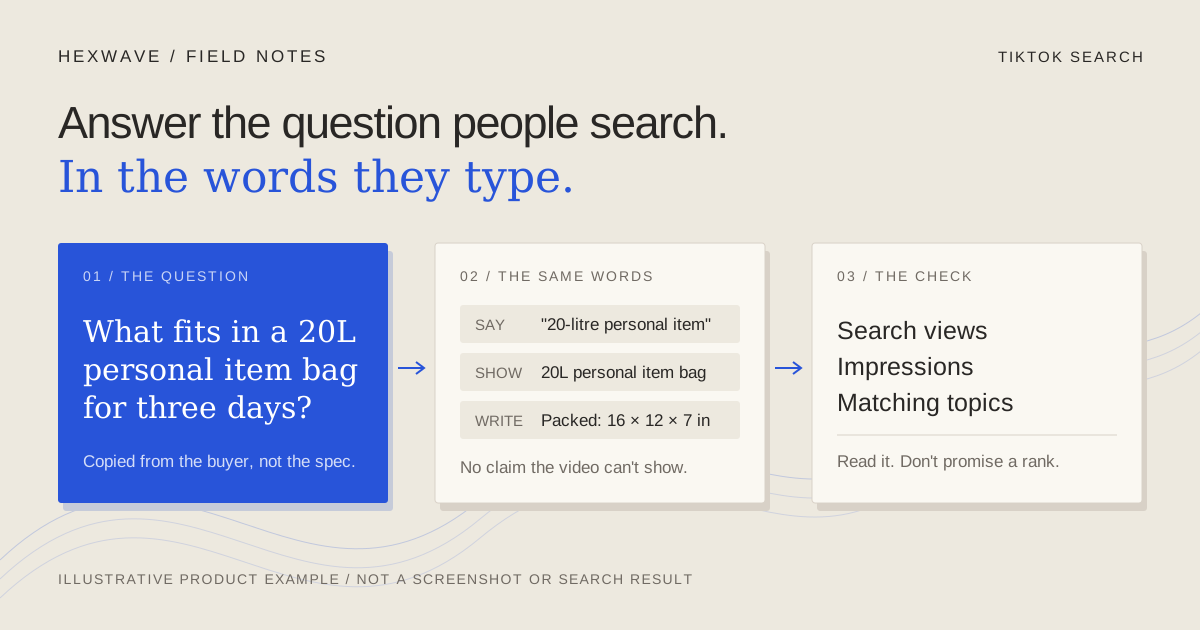
"What fits in a personal item backpack for three days?" A question the video can answer completely, on camera, with the real bag. You pack specific items into it and show that they fit.
We'll carry the third question forward. It's specific, it uses the phrase buyers search, and the answer is a demonstration rather than a promise.
Notice one problem it brings with it. "Personal item" isn't just a keyword; it implies the bag meets an airline's size limit. Using the buyer's words doesn't let you borrow a claim the facts don't support. The video has to show the measured dimensions and tell people to check their own airline, which turns a potential overclaim into useful information.
Say it, show it and write it in the same words
Now put the question where TikTok's guidance says to put it. The aim is consistency: someone who searched the phrase should recognize their question within the first few seconds, whether they're listening, reading the screen or scanning the caption.
Spoken line (first seconds): "Here's everything that fits in this 20-litre personal item backpack for a three-day trip."
On-screen text over the opening frame: "What fits in a 20L personal item bag (3 days)"
Cover text: "3 days in a 20L personal item bag"
Demonstration: Lay out the exact items, pack them in order, close the bag, then measure it with a tape measure: 16 × 12 × 7 in.
Caption: "What fits in a 20L personal item backpack for 3 days: 2 shirts, 1 pair of trousers, a sweater, a toiletry bag and a 14-inch laptop. Packed size 16 × 12 × 7 in. Personal-item limits vary by airline, so check yours before you fly."
Hashtags: Two or three that describe the video, such as #packinglist and #personalitem. Not a list of everything travel-related.
A few choices in that example are deliberate.
The spoken line and on-screen text don't match word for word, and they don't need to. People don't talk in search phrases. What matters is that the core words, "20L," "personal item" and "three days," appear in all of them, so the topic is unambiguous.
The caption answers the question in text, not only in pictures. A searcher skimming the result can see the item list and the dimensions. That is also a natural place for the boundary sentence about airlines.
The cover states the topic. TikTok specifically mentions titles and covers as a way to make the theme clear for search, and a cover that says "wait for it" tells a searcher nothing.
The opening still has to work as an opening. Search relevance doesn't excuse a slow start; the hooks guide covers matching that first line to a frame the product can deliver on. And the packing itself is a demonstration, so the product demo guide applies: show the items, don't cut from empty bag to closed bag.
What makes it worse
The failure modes are mostly about saying more than the video is about.
Stacking keywords. Adding "carry on, travel backpack, airport hacks, minimalist packing, weekend bag" to the caption of a video about one 20L bag makes the topic less clear, not more. TikTok says irrelevant text can hurt traffic and hidden or unrelated on-screen text can be flagged as spam.
Borrowing a popular phrase the video doesn't answer. If "carry on luggage" is searched more than "personal item backpack," it's tempting to use it. But a carry-on and a personal item are different allowances, and a viewer who searched for one will notice. TikTok's guidance asks for an accurate, objective description of the video.
Letting the search phrase inflate the claim. "The only personal item bag you'll ever need" contains the keyword and a promise the facts can't support. Run the finished wording through the same content review you'd use for any other post.
Check whether search is finding it
Once the video is live, the question is whether people are reaching it by search, not whether it went viral.
If you have Search Analytics, look at search views and search view percentage first. They show how much of the video's audience came from search. Search impressions and click-through rate tell you whether it's appearing in results and whether people choose it when it does. TikTok also reports an average search ranking and the search topics your content is showing up for. Compare those topics with the question you meant to answer; if they differ, the video may be about something other than what you intended.
Searching for the phrase yourself is a weak test. What you see is one set of results on your account at one moment. It can be a useful sanity check that the video appears at all, but it isn't a ranking report.
Give the judgment more than one post. A single video that does well in search tells you that video matched that query for those viewers. It doesn't prove that a phrasing pattern always wins, and a single weak result doesn't prove the question has no demand. Keep a short record for each post: the target question, the spoken line, the on-screen text, the caption, the publish date and what Search Analytics showed after a week or two. Patterns across several questions are worth more than one surprising number.
Nobody outside TikTok can promise you a ranking, and TikTok doesn't publish how it calculates one. What you can control is whether a searcher who finds the video gets the answer they asked for.
Reels and Shorts
This guide covers TikTok only. The question-first script travels well: a video that answers one buyer question clearly is useful wherever it's posted. But Instagram and YouTube publish their own guidance and their search features are separate systems. Don't assume that what TikTok says about captions or covers applies to them; check each platform's own documentation before rewriting captions for it.
Start with one question
Pick one question from your support inbox or reviews that your footage can answer completely. Write it down in the buyer's exact words. Then write the spoken line, the on-screen text and the caption beside it, and check that each uses the same core words without promising more than the video shows. If you can't make that work, the question needs narrowing before the video needs editing.
Sources & reference material
- Driving video traffic: Search — TikTok Creator Academy, checked October 14, 2026. Page shows last updated 18 Aug 2026. States that Search values relevance over views and engagement, names relevance and video quality as the two points to focus on, and warns that irrelevant keyword stacking hurts traffic. Gives no ranking factors or weights.
- Getting discovered with Search: Your questions answered — TikTok Creator Academy, checked October 14, 2026. Recommends using the description, voiceover, captions and on-screen text to make the topic clear; says unrelated or hidden on-screen keyword text can be flagged as spam and long hashtag lists can work against a video; says the followers' searches filter needs 1,000 followers. Guidance, not a ranking specification.
- Why you should care about Search Analytics — TikTok Creator Academy, checked October 14, 2026. Page shows last updated 18 Aug 2026. Defines search views, search view percentage, search impressions, average click-through rate and average search ranking inside Creator Search Insights. Does not explain how ranking is calculated.
- Raising your Search ratings with the Content gap tab — TikTok Creator Academy, checked October 14, 2026. Page shows last updated 18 Aug 2026. Describes the Content gap tab and the steps to open it. Its statement that gap videos are more likely to rank higher is TikTok's own encouragement, not published measurement.
- Get inspired with Creator Search Insights — TikTok Newsroom, checked October 14, 2026. Dated 13 March 2024. Introduces Creator Search Insights as available in select regions and defines content gap topics. Read from a 7 Oct 2026 web archive capture because the page did not load directly from our network. Availability may have changed since publication.
- How TikTok recommends videos #ForYou — TikTok Newsroom, checked October 14, 2026. Dated 18 June 2020 and about the For You feed, not Search. Lists user interactions, video information such as captions, sounds and hashtags, and device and account settings; says follower count is not a direct factor. Read from a 12 Oct 2026 web archive capture.