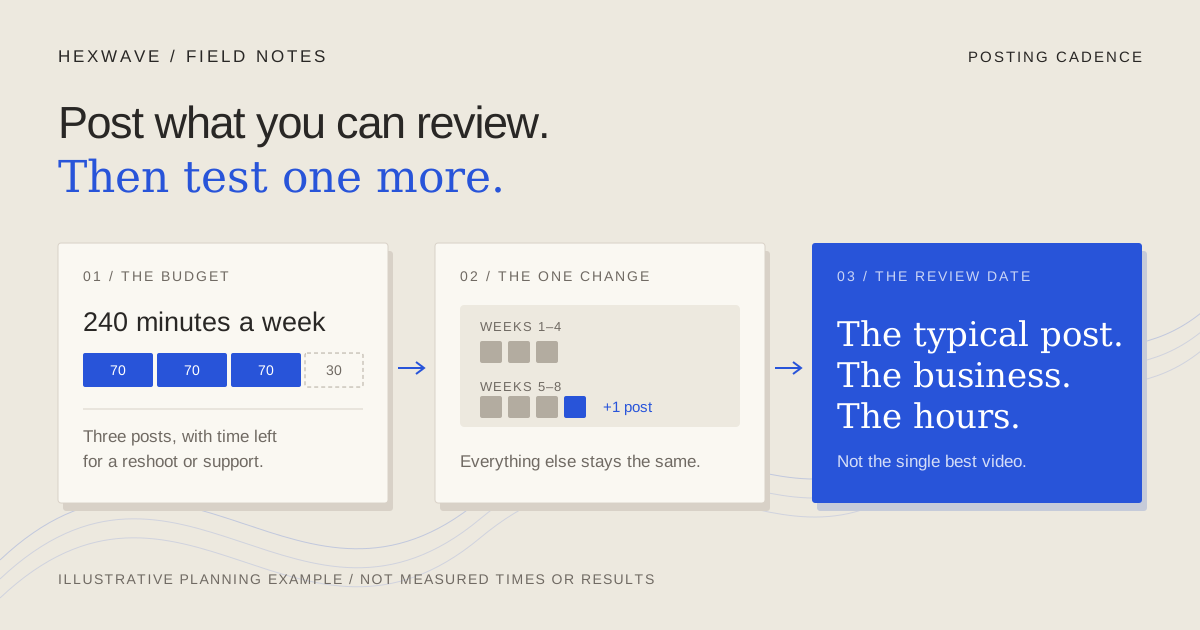
If you're a small brand with one or two people making content between other jobs, start with two or three TikTok posts a week. Hold that pace for four weeks, then decide whether to add one more.
That range is a capacity decision, not an algorithm setting. It's enough posts to learn something within a month, and few enough that each one can still get a real brief and a real review. If you can comfortably do more without dropping either, you can start higher. If you can only finish one good post a week, one good post a week is a legitimate plan.
The rest of this guide explains where that starting point comes from, what TikTok actually says about frequency, and how to test a change without confusing yourself or borrowing the hours you need for customers.
What TikTok says, and what it doesn't
TikTok doesn't publish a posting number for businesses. Its creative strategy guide for small businesses says you don't need to post daily, and that making a schedule and sticking to it helps build momentum. That's the closest thing to an official answer for a product brand.
There's a stronger-sounding page in TikTok's Creator Academy. It says there's no one-size-fits-all answer, reports that publishers posting several times a day saw more views and For You exposure, and recommends setting a daily target you can consistently hit. It's written for news and sports publishers, who have a steady supply of new events to cover. A company selling a project-management tool or a ceramic planter does not.
You'll also see "TikTok recommends one to four posts a day" repeated across posting-frequency articles. We couldn't find that figure on a current TikTok page, and the articles repeating it generally don't link to one. Treat it as unverified until someone shows the source.
What TikTok has explained is how recommendations work. In its 2020 newsroom explanation, it said the For You feed is driven by viewers' interactions and information about the video, that neither follower count nor previous high-performing videos are direct factors, and that the feed tries not to show two videos in a row from the same creator (TechCrunch's report quotes the same points). That explanation is six years old, so don't treat it as a current specification. It does suggest a useful way to think about frequency: each post gets its own chance with viewers, and posting a fourth video today doesn't put it in front of the same person three times in a row.
We found no official TikTok statement that skipping a day penalizes an account. If someone tells you it does, ask for the source.
More attempts are not the same as an algorithm preference
The best public data on this question comes from Buffer, a social scheduling company. Its 2025 study compared each account's posts with that same account's own history, so a big brand posting often isn't simply being compared with a small one posting rarely.
Read the median and the top decile together. The typical post did not get better when accounts posted more. What changed was the chance of an unusually good one. Buffer's own interpretation is roughly that: more posting raises the odds of a breakout rather than lifting every post.
That's a meaningful finding, but it's a different claim from "the algorithm rewards daily posting." More posts mean more attempts, and more attempts mean more chances that one finds an audience. For a media company, that may be the whole job. For a small brand, every extra attempt costs time that could have gone into a better demonstration, a support reply or the product itself.
The Buffer data also supports a modest version of the starting answer. The biggest lift per extra post came from moving off one post a week. Beyond that, returns per post shrank. So if you're at one a week, two or three is a reasonable first move. Whether a fourth or tenth post is worth it depends on what it costs you, which the study can't tell you.
Choose the pace from three limits
A useful cadence comes from three limits, checked in this order. Each can lower the number; none of them can raise it above what the others allow.
Capacity. Protect the time for customer support and product work first, then decide how many hours belong to content. Count the whole job per post: choosing the question, checking the facts, capturing, editing, reviewing the exact export and checking that it actually appeared. The content-planning guide walks through that budget in detail.
Quality bar. Each post needs a distinct buyer question and a product fact you can show. If you can't name the question, the post isn't ready, whatever the calendar says. A filmable brief is the quickest way to find out whether you have three distinct posts or one post written three ways.
Business outcome. Decide what you're trying to learn about customers before you count posts. That might be whether people ask about price in comments, whether profile visits lead to site visits you can track, or which questions keep coming up. Views alone tell you something about distribution, not whether the right people are paying attention.
A worked week
This is an illustrative example. The times are planning assumptions, not measured production times.
A two-person team sells a small software product. They've decided support and product work come first, which leaves four hours a week (240 minutes) for TikTok. Each post needs 10 minutes to finish the brief, 20 to capture, 25 to edit, 10 to review and 5 to publish and check: 70 minutes.
Three posts take 210 minutes. That leaves 30 minutes for a reshoot, a correction or a support question that can't wait. A fourth post would need 280 minutes, which is more than the budget, so the plan is three a week.
That number came from the team's week, not from TikTok. If their edits take 40 minutes instead of 25, the per-post total becomes 85 minutes, three posts take 255, and the honest plan becomes two posts a week with room to spare. The arithmetic changes with the inputs; that's the point of writing them down.
Test one change for four weeks
Once the starting pace has run for a few weeks without breaking review or support, you can test a change. Change one thing. If you go from three posts to four and also switch from screen recordings to talking-head videos, any difference has two possible causes and you won't know which.
Keep the review standard, the format mix, the kinds of questions and the posting window as stable as you can. Give the change four weeks; a single week can be swamped by one unusual post.
Here's a cadence sheet, filled in for the illustrative team above. Copy the left column and replace the right.
| Field | Example (illustrative) |
|---|---|
| Current pace | 3 posts a week, held for 4 weeks |
| The one change | Add a 4th post each week |
| Held constant | Screen-recorded demos, same review step, same posting window, one buyer question per post |
| Where the time comes from | Record two demos per setup, assumed to cut capture from 20 to 10 minutes a post: 4 × 60 = 240 minutes, with no spare time left |
| Test period | Weeks 5–8 |
| Review date | End of week 8, written on the calendar now |
| Typical post | Median views per post, compared with weeks 1–4 (not the single best post) |
| Business signal | Comments asking about price or setup; tracked site visits from the profile link |
| Cost | Actual minutes spent per week, from rough notes made during the work |
| Stop rule | Return to 3 a week if any post skips review, or support replies fall behind for two days running |
Two things on that sheet do most of the work. The stop rule protects the parts of the business that are paying for the experiment. The review date stops the test from becoming the new default simply because nobody looked at it again.
In this example, the time row is the fragile one. The fourth post only fits if batching saves the assumed ten minutes, and it uses up the 30 spare minutes that used to absorb a reshoot. If the notes show the week running over, that's a result, and it arrives before the views do.
Note what the sheet doesn't promise. An organic comparison over four weeks isn't a controlled experiment. Topics differ, weeks differ and a single video can travel for reasons you'll never see. You're looking for a clear enough difference to make a decision, not proof.
Read the result
At the review date, look at the typical post, the business signal and the hours together. Here's how the combinations usually translate into a decision.
| What you see | What to do |
|---|---|
| The typical post holds steady, the business signal is similar or better, and the hours fit | Keep the higher pace. The extra post earned its time. |
| The typical post holds steady, but nothing changes in the business signal | Either is defensible. Going back frees an hour a week for better posts or other work. |
| The typical post drops, or reviews got rushed | Go back. You traded quality for count, and the median is telling you so. |
| Support or product work fell behind | Go back, regardless of views. The stop rule exists for this. |
| One post did unusually well | Don't credit the frequency. Study that post's question and opening instead. |
The last row matters most. A breakout post is the outcome the Buffer data says more attempts make more likely, which is exactly why it can't, by itself, prove that the new pace caused it.
When daily posting makes sense, and when to post less
Daily posting can be a reasonable choice for a small brand when three conditions hold: there's a repeatable format with low production cost, a steady supply of genuinely distinct material (customer questions in comments are a good source), and a named person whose job includes it without displacing support. If those hold, daily posts are more attempts at a cost you can carry. If they don't, daily posting usually means repeating yourself or skipping review.
Posting less is sometimes the right call too. A launch week, a support backlog or a product problem is a good reason to drop to one post or pause. TikTok's small-business guidance asks for a schedule you can stick to, and a reduced schedule you actually keep fits that better than a full one that quietly collapses. Write the change on the calendar so the gap is a decision, not something you discover later.
If you need help making several posts in one sitting, the batch-production guide covers grouping shots by setup. The free TikTok content calendar lets you choose a posting pace and lay out briefs against it.
The short answer, again
Start with the number of posts you can brief, make and review well in the hours left after customers and product: for many small teams that's two or three a week. Hold it for four weeks. Then change one thing, set a review date and a stop rule, and judge the result by the typical post, the business signal and the time it cost.
There's no official TikTok number to hit. The pace that works is the one that keeps teaching you something about your customers without taking time from them.
Sources & reference material
- TikTok Creative Strategy Guide for Small Businesses — TikTok for Business, checked October 14, 2026. Official TikTok guidance that small businesses don't need to post daily and should keep a schedule they can stick to. Wording checked through search-index extracts because TikTok domains refused direct connections from our environment on the check date; re-read the live page before publication. It gives no frequency number and no performance data.
- Posting cadence best practices for publishers — TikTok Creator Academy, checked October 14, 2026. Official guidance written for news and sports publishers: no one-size-fits-all answer, publishers posting several times a day saw more views, set a daily target you can consistently hit. Checked through search-index extracts; the page refused direct connection on the check date. The success cases are not published as data and the audience is not small product brands.
- How TikTok recommends videos #ForYou — TikTok Newsroom, checked October 14, 2026. June 2020 explanation: recommendations depend on viewer interactions and video information; follower count and past high-performing videos are not direct factors; the feed avoids two videos in a row from the same creator. Wording confirmed through TechCrunch's same-day report. The system may have changed since 2020; it says nothing about posting frequency.
- TikTok explains how the recommendation system behind its 'For You' feed works — TechCrunch, checked October 14, 2026. Secondary report quoting TikTok's 2020 newsroom post on follower count, past performance and repeat creators. Used only to confirm the quoted wording, not as independent analysis.
- How Often Should You Post on TikTok? Data From 11 Million+ Posts — Buffer, checked October 14, 2026. Vendor study published October 8, 2025: 11.4 million posts from over 150,000 accounts using Buffer, fixed-effects comparison of each account with itself. Mean views per post rose with weekly frequency while median views stayed roughly flat and top-decile views rose. Observational and limited to views; the analysis period is not stated; it does not measure sales, signups or production cost, and its sample is self-selected scheduler users.